Swap the Season, Keep the Square Footage: A Studio Dweller's Guide to Rotating Winter Gear
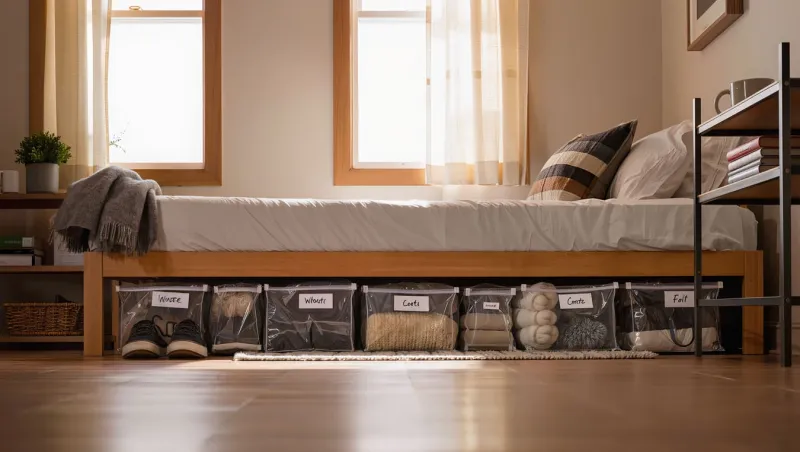
Photo: vacuum storage bags under bed seasonal clothing small apartment, via smartspaceliving.net
Every March, something strange happens at i65 Studio Suites: residents start hauling things out. Not in — out. A duffel bag of wool sweaters here, a box of string lights there. The seasonal rotation has begun, and in a studio, it's less of a chore and more of a small搬家 — minus the 搬家 part, because you're not going anywhere.
Wait. Let's start over, in English.
Every March at i65 Studio Suites, residents begin the great swap: winter gear out, warm-weather stuff in. If you live in 400 square feet, you already know there's no such thing as "putting it in the attic." There is no attic. There is no garage. There is the space under your bed, the top of your closet, and your own discipline. Here's how to make all three work.
The Under-Bed Zone Is Prime Real Estate
The average bed frame in a studio sits 6 to 10 inches off the floor. That's not dead space — that's your basement. But it only works if you treat it like a system, not a junk drawer.
- Low-profile rolling bins (under 6 inches tall) fit most frames and slide out when you need them. Get ones with wheels; dragging a full bin across carpet is a small war you'll lose.
- Vacuum-seal bags are the honest workhorse here. A down comforter that fills a 30-gallon bin compresses to roughly the thickness of a textbook. Fair warning: they never re-fluff quite as springy as before, and every veteran of vacuum-bag living knows the re-rolling struggle. Use them for puffy items, not for anything you'd hate to see wrinkled.
- Divide the zone in two: one half for the current season's overflow, one half for the off-season stuff. When the seasons turn, you swap sides. Done.
If your frame sits low, risers are the cheapest renovation you'll ever do. Six inches of lift roughly doubles your storage volume.
The Big Stuff: A Storage Math Reality Check
Some things genuinely don't fit. Snow tires, a kayak, Great-Aunt Denise's three-foot ceramic snowman. This is where you run the numbers.
A 5x5 off-site storage unit runs about $50–$90 a month in most mid-sized US markets — call it $600 to $1,000 a year. Before you sign, ask yourself what's actually in there. If it's $700 worth of camping gear you use eight weekends a year, that's roughly $90 per trip. Fine, if the trips are worth it to you. If it's two boxes of college textbooks you haven't opened since 2021, that's not storage — that's a subscription to guilt.
Cheaper alternatives worth trying first:
- Shared closet apps and peer storage (think Neighbor-style platforms) often run $20–$40 a month for a garage shelf space.
- Tires: many tire shops and some dealerships offer seasonal tire storage for a modest fee, sometimes free if you bought the tires there. Ask.
- The one-in, one-out rule: if a new winter coat comes home, an old one leaves. Donation centers near the I-65 corridor are never hurting for coat drives in November.
A Month-by-Month Swap Schedule
The trick to studio storage isn't finding more space — it's never having two seasons fully deployed at once. Try this rhythm:
- March–April: Winter coats to vacuum bags; comforter swap; holiday bins to the closet top.
- May: Camping and beach gear comes forward. If it doesn't fit, something goes.
- September: Light jackets replace shorts. This is also the month to be honest about that swimsuit situation.
- October–November: Heavy coats out of bags (air them out for a day — vacuum memory is real), holiday decor staged but not deployed, tires swapped before the first freeze.
- January: The post-holiday purge. Whatever decor didn't get put up this year goes in the donation pile before it eats closet space for eleven more months.
The One-Rule Summary
In a studio, seasonal storage isn't about containers — it's about turnover. Keep one season active, one season packed, and nothing "just in case." Your 400 square feet will feel twice as big, and you'll never again dig through a bin of July to find a flannel.