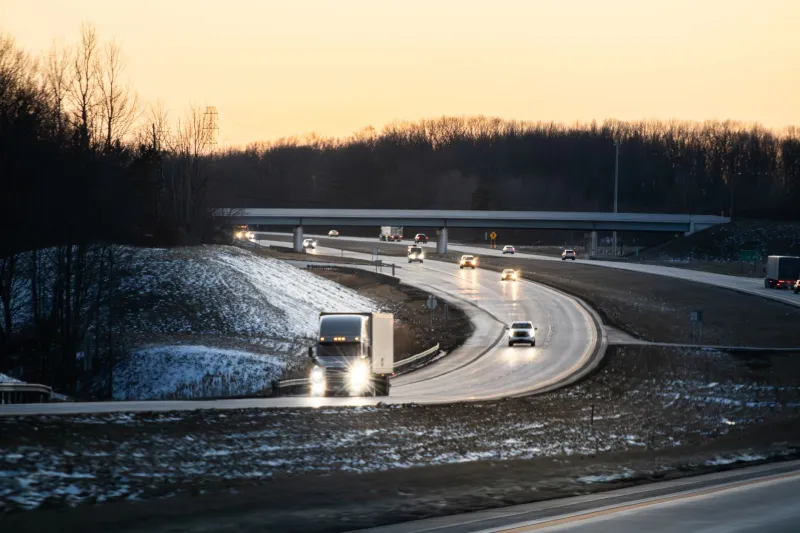
300 Feet From the Freeway: An Honest Look at Highway Noise and Your Sleep

Let's address the thing everyone's thinking but few tour guides bring up: the highway.
Living near I-65 is the whole pitch — quick commutes, easy weekend trips, no spiraling through surface streets to get anywhere. But proximity has a soundtrack, and if you've never lived near a major interstate, you probably have questions. Reasonable ones. Like, will I sleep?
We wanted real answers, not brochure answers. So here's a straight look at what highway-adjacent living actually sounds like, what the numbers say, and what you can do about it.
First, the Numbers: How Loud Is an Interstate, Actually?
Traffic noise is measured in A-weighted decibels (dBA) — the scale that approximates how human ears hear things. A highway with moderate traffic at about 300 feet away typically registers somewhere between 55 and 65 dBA. For context:
- A quiet bedroom at night: ~30 dBA
- A normal conversation: ~60 dBA
- A dishwasher running: ~70 dBA
- A vacuum cleaner a room away: ~75 dBA
So no, your apartment isn't going to feel like you're sleeping on the shoulder. At a few hundred feet of distance, highway noise flattens into something closer to a steady, low-level hum than a series of distinct events. Distance does most of the heavy lifting here — sound level drops roughly 6 dB every time you double the distance from the source.
There's a wrinkle, though: the average isn't the problem. The average is fine. What people notice is the variation — a motorcycle accelerating at 2 AM, a jake brake from a semi, a siren merging on. Those spikes are what jolt people awake, not the ambient drone.
The Physics of Not Hearing Things
Here's the good news: a well-built building is surprisingly good at its job. Modern construction codes in most US markets require exterior walls with insulation and double- or triple-pane windows, and that combination can cut perceived noise by 25 to 30 decibels. Your exterior wall is the filter; the interstate is on the other side of it.
A few things matter more than others:
Windows are the weak point. Sound leaks through glass and gaps far more easily than through framed, insulated walls. If you close a window and the highway suddenly sounds close again, that's why. Upgraded or well-sealed windows can be the difference between "murmur" and "traffic report."
Height cuts both ways. Higher floors get you away from ground-level noise — parking lots, landscaping equipment, the dumpster at 6 AM. But elevation can also give you a clearer line to the highway itself. Lower floors near buildings and terrain get natural sound shielding; upper corner units often face the road more directly.
Orientation is everything. On any property near a corridor like I-65, some floor plans face the interstate and some face away. Buildings, courtyards, and even tree lines between your unit and the road act as barriers. This is the single most useful question you can ask on a tour: which direction does this unit face?
Do You Actually Stop Noticing It?
Honest answer: mostly, yes — and faster than you'd think.
There's real psychology behind this. Constant, steady background noise is what researchers call "masking" — your brain files it under ambient and stops flagging it. It's the same reason people who live near train tracks claim they don't hear the 10:45 freight, while their visiting friends lie awake staring at the ceiling. Adaptation is genuine, and it typically takes a couple of weeks.
The spikes are the exception. Occasional loud events — that motorcycle, the horn — will register longer than the hum does. If you're a light sleeper, plan for that rather than pretending it won't happen.
It's also worth being honest about the flip side: some people find the steady white-noise quality of highway hum helpful for sleep. It covers the neighbor's TV, the hallway conversation, the 3 AM text buzz. Silence isn't the only sleep-friendly soundscape.
Practical Fixes That Actually Work
Whether you're highway-adjacent or just next to a busy surface road, these are the moves that make a measurable difference:
1. Run white noise — deliberately. A fan, a white noise machine, or a sleep app playing steady sound raises your baseline and flattens those traffic spikes. This is the cheapest, highest-impact fix available, and it works the same night you try it.
2. Upgrade your window situation. Blackout curtains do double duty — they block light and add a dense fabric layer that dampens sound. For serious results, floor-to-ceiling panels hung slightly away from the wall beat standard curtain rods. Weatherstripping around window frames seals the gaps sound sneaks through.
3. Rugs and soft surfaces. Hard floors reflect sound; textiles absorb it. In a studio, a thick rug isn't just a design choice — it's acoustic treatment.
4. Rethink your floor plan layout. If your unit faces the road, put your bed on the interior-facing wall. Two walls between you and the highway beats one. In a studio this takes some creativity, but bed placement is the highest-leverage furniture decision you'll make.
5. Earplugs, unashamedly. Foam earplugs cut 25+ dB and cost pennies. Plenty of long-term highway-adjacent residents use them for the first month while their brains adapt, then quietly stop needing them.
What to Ask on Your Tour
If you're touring a property near I-65 (or any interstate), add these to your list:
- Which units face the highway, and which face away?
- Are the windows double-pane?
- What's between the building and the road — another building, a berm, trees?
- Can I stand in the unit with the windows closed and just... listen for two minutes?
That last one feels awkward and is completely worth it. Tour in the evening if you can, since traffic noise peaks with volume, not just congestion.
The Bottom Line
Living 300 feet from an interstate is not the sleepless existence people imagine from the outside. The steady hum fades into the background for most residents within weeks, modern construction handles the bulk of the filtering, and the fixes for the rest are cheap and immediate.
The real variable isn't the highway — it's whether you chose a unit that faces it. Ask the right questions, pick your orientation wisely, keep a fan running, and the I-65 lifestyle delivers exactly what it promises: you're on the road in minutes, and off to sleep just as fast.