The Spot You Didn't Tour: Figuring Out Where Your Car Actually Sleeps
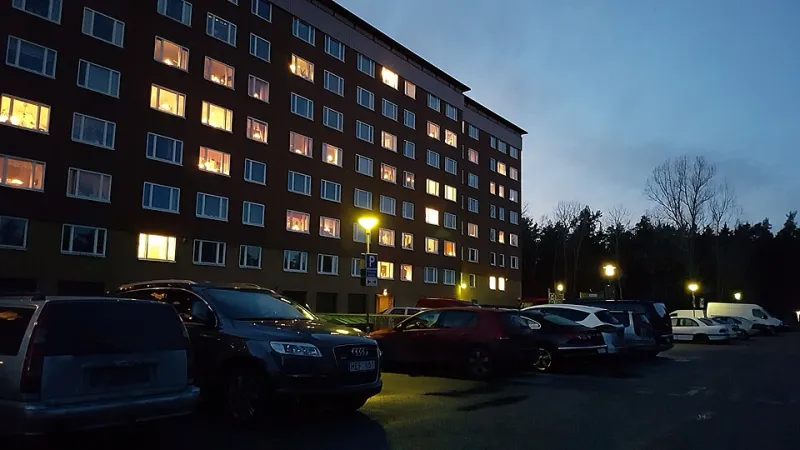
Photo: HendrixHammer, CC BY-SA 4.0, via Wikimedia Commons
The amenity that never makes the brochure
A studio complex near I-65 sells itself on the things you can photograph: the gym, the courtyard, the quartz countertops, the ten-minute hop to the on-ramp. Parking shows up as a line item, if it shows up at all.
But for anyone who commutes, parking is not a footnote. It is the first and last five minutes of every day. Get it wrong and you are circling a block at midnight, or paying a tow bill that costs more than a month of the spot you decided not to rent.
Here is what to actually look at.
Assigned, unassigned, and the waitlist
There are three basic setups and they feel completely different in practice.
Assigned spots come with a number, usually painted on the pavement or on a garage level. You park in the same place every day. The upside is obvious: no hunting, no guessing. The catch is that assigned spots are often a separate monthly charge, sometimes bundled into the lease and sometimes not. Ask which one applies to the unit you are looking at, and get the number in writing. If the spot is included, confirm that it is assigned to your unit and not to the building generally.
Unassigned or first-come parking is cheaper and more stressful. It works fine at 2 p.m. on a Sunday and poorly at 9 p.m. on a weeknight. If the lot consistently fills, the overflow is a street with signed restrictions and a towing company that knows the schedule.
Waitlists are the honest version of a shortage. Some buildings sell parking only to residents who have been there a while, or cap spots at one per unit. Ask where you are on the list, how fast it moves, and what you are supposed to do in the meantime. "There is a list" is not an answer you can plan a commute around.
Tandem spots and the roommate question
Tandem parking means two cars stacked in one space — one behind the other. It is common in older buildings and in garages that were retrofitted.
Tandem works beautifully if the two drivers have opposite schedules. It is miserable if you both leave at 8 a.m. It also puts the front car's driver in charge of the back car's morning. Nobody wants to move a car at 6:45 because someone else has a shift.
If you are sharing a studio with a partner or a roommate and both of you drive, ask directly: is this a tandem spot, and if so, who is in front? And what happens when one car is blocked and the other driver is out of town?
Guest parking is a real line item
Everybody asks about guest parking during the tour. Almost nobody asks the follow-up questions, which are the ones that matter.
- How many guest spaces exist, and are they marked?
- Is there a permit, a time limit, or a register-your-guest system?
- What are the towing rules, and who enforces them?
- Are guests allowed in the garage, or only in the surface lot?
In a building near an interstate, guest parking is often the first thing to disappear because the location is convenient for everyone. If you regularly host a partner, a sibling, or friends driving in for the weekend, an unenforced guest policy turns into your problem and their tow bill.
Two wheels instead of four
Not everyone needs a car spot, and the alternatives deserve the same scrutiny.
Motorcycles and scooters usually need a designated area, not a corner of the garage. Ask where they go, whether they need a permit, and whether the space is covered. A bike left under a leaky garage ceiling is a maintenance project.
Bicycles are increasingly handled with a dedicated room or a rack. Ask whether it is secured, whether it is indoors, how many slots exist relative to the number of units, and whether you need to register. If the building sits near a greenway or a bike lane to campus or the office, that rack might save you more money than the car spot costs.
EV charging is worth a specific question even if you do not own an EV yet. Are there chargers, how many, and are they assigned or shared? Shared chargers in a small garage can turn into a scheduling problem within a year.
Details that show up later
A few specifics that separate a good parking situation from a bad one, none of which appear on the brochure:
Spot width. Older garages were built for smaller cars. If you drive a truck or a full-size SUV, ask about clearance and width before you commit. Door dings are a rent-sized expense over a year.
Garage access hours. Some garages close or lock overnight. If you work a late shift, that gate matters more than the gym.
Gate and door maintenance. Ask who fixes the arm gate when it breaks, and how residents get in during an outage. A gate stuck open on a Friday night is a security issue; a gate stuck closed is a missed flight.
Snow and ice. If you are in a market that gets winter weather, ask who plows, in what order, and whether surface lot cars need to move on plow days.
Lease language. Parking is often licensed rather than leased, which means the building can reassign or reclaim the spot. Read the paragraph. If parking is essential to your schedule, ask whether the spot number is written into your lease.
The five questions to ask before you sign
- Is my spot assigned, and is the number in the lease?
- What does it cost per month, and is it bundled or separate?
- How many guest spaces exist, and what are the towing rules?
- Where do motorcycles and bicycles go, and do they need a permit?
- What is the backup plan when the lot is full?
Ask these while you are standing in the garage, not after the lease is signed and the car is on the street. The ten-minute version of the tour is the one that saves you the 11 p.m. version of your week.