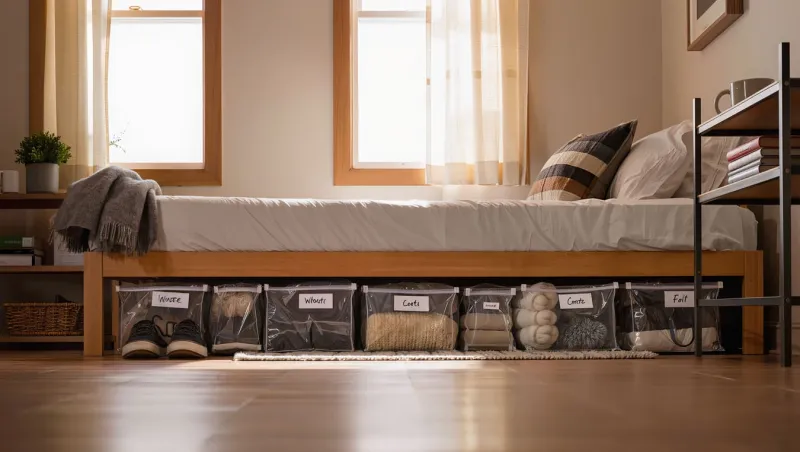
Six Steps to Lights Out: The Case for a 15-Minute Studio Shutdown
Photo: Jan Kalinowski, CC BY-SA 4.0, via Wikimedia Commons
Here's something nobody tells you before you move into a studio: the thing that makes small spaces feel overwhelming by day is the exact thing that makes them incredibly easy to reset at night.
In a traditional apartment, "cleaning up" means committing to multiple rooms, hauling dishes to a separate kitchen, and pretending the living room counts as a separate trip. In a studio? Everything you need to touch is within arm's reach of everything else. That's not a limitation — that's a built-in efficiency system waiting to be used.
Why Small Spaces Make Habits Easier, Not Harder
Behavioral researchers have been saying it for years: proximity drives habit formation. The fewer steps between you and a behavior, the more likely you are to actually do it. In a studio, the "steps" part is almost literal.
Your dishes are six feet from the sink. Your laundry basket is visible from your pillow, which means you can't successfully ignore it. Your desk, your kitchen, your closet — it's all one continuous zone, which means one pass through the space touches every part of your life at once.
Big apartments let clutter hide in spare rooms and guest bathrooms. Studios have nowhere to hide it, which sounds like a complaint but is actually the point. When everything is visible, everything gets handled.
The 15-Minute Reset, Zone by Zone
The trick is to stop thinking of your studio as one big room and start thinking of it as four overlapping zones. Work through them in order, and the whole thing wraps in about a quarter hour.
Zone 1: The Kitchen (5 minutes)
Don't aim for spotless — aim for closed. Wash or load the day's dishes, wipe the counter, and put the sponge somewhere it can dry. In a studio, a messy kitchen is also a messy everything, so this zone earns the biggest slice of the clock.
- Rinse or load every dish
- Wipe counters and the stovetop
- Empty coffee grounds or toss food scraps
Zone 2: The Living/Sleeping Zone (4 minutes)
Fold the throw blanket, fluff the pillows, and — this is the big one — make the bed or at least straighten it. In a space where your bed is also your sofa, an unmade bed drags down the whole room. Thirty seconds here buys you an hour of feeling like a functional adult.
Zone 3: The Work/Entry Zone (3 minutes)
Clear the desk or table, corral loose chargers, and set out tomorrow's essentials: keys, badge, water bottle, whatever your morning self will thank you for. If your commute involves I-65, put your keys on top of your wallet tonight and skip the 7 a.m. panic search entirely.
Zone 4: The Floor Sweep (3 minutes)
One quick pass — pick up clothes into the hamper, shoes to the door, mail to a single designated pile. Set a timer if it helps. When the timer dings, you're done, whether or not it's perfect.
Habit-Stacking Your Way to Consistency
The reset only works if it happens automatically, and the easiest way to get there is to anchor it to something you already do. Classic habit-stacking looks like this:
- After dinner → run the kitchen zone
- After your last email → clear the desk
- After brushing your teeth → do the floor sweep
Pick one anchor first. Don't try to stack all four zones onto one trigger on day one — you'll burn out by Thursday. Most people find the kitchen is the natural starting point, because nothing else in a studio feels clean while the sink is full.
A small playlist helps too. Fifteen minutes is roughly three songs. When the music stops, you stop. It turns a chore into something with a hard endpoint, which is honestly half the battle.
The Payoff: Better Mornings, Better Sleep
There's a reason the "don't go to bed with a messy kitchen" advice is everywhere — waking up to a reset space measurably lowers your baseline stress. In a studio, that effect is amplified because there's no closed door between you and the mess. Your bedroom is your living room is your kitchen. A clean zone is a clean everything.
The morning benefit might be even bigger. With tomorrow's stuff staged and the counters clear, your exit routine shrinks to minutes. For anyone commuting on the I-65 corridor, those reclaimed minutes are the difference between a calm drive and a white-knuckle sprint to the on-ramp.
Start Tonight
Don't overthink it. Set a 15-minute timer, start with the dishes, and work your way around the room in one direction. By the end of a week, you'll have a routine that runs itself — and a 400-square-foot apartment that greets you like a hotel every single morning.
Small space, small reset. That's the whole deal.